

Cats have lived alongside humans for thousands of years, yet many people still underestimate their intelligence. Unlike dogs, cats rarely perform tricks simply to please their owners. Instead, they tend to solve problems independently and often learn through observation and experience.
So, how smart are cats really?
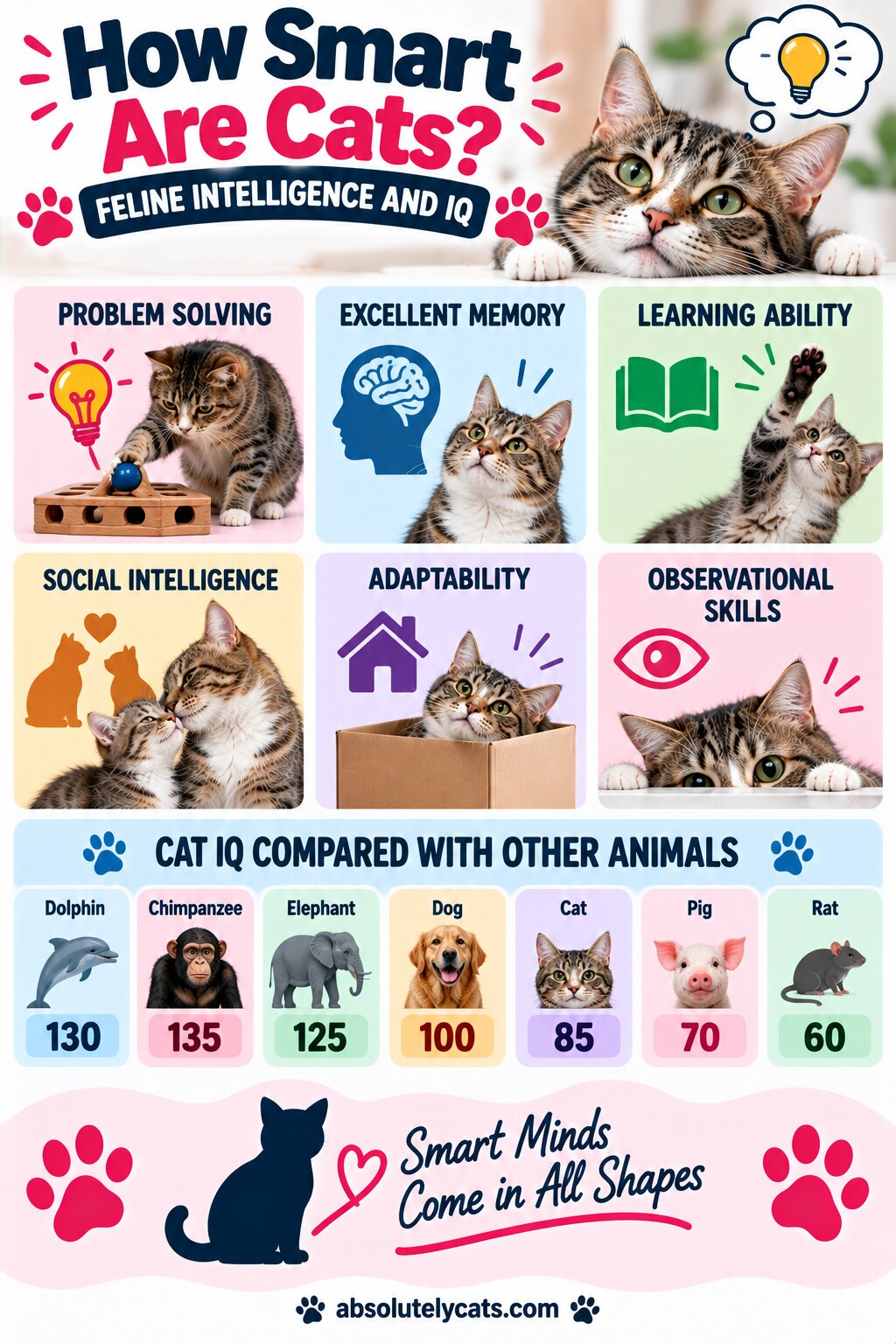
While scientists cannot measure feline intelligence exactly the same way they measure human intelligence, research shows that cats possess impressive cognitive abilities. They can learn routines, remember locations, recognize people, communicate their needs, and solve various everyday problems.
This guide explores feline intelligence, cat brain facts, IQ comparisons, signs of a smart cat, and the breeds often considered the most intelligent.
Are Cats Smart?
Yes, cats are intelligent animals.
Although their intelligence differs from human intelligence, cats demonstrate several advanced cognitive skills, including:
- Long-term memory
- Problem-solving
- Learning through observation
- Spatial awareness
- Social recognition
- Communication skills
- Adaptability
Cats evolved as solitary hunters. Consequently, they developed intelligence that helps them survive independently rather than cooperate in large groups.
This difference often makes cats appear less trainable than dogs, even though they possess impressive mental abilities.
What Makes Cats Intelligent?
Intelligence involves more than learning tricks.
Scientists evaluate animal intelligence using several factors:
- Memory
- Learning ability
- Adaptability
- Communication
- Problem-solving
- Environmental awareness
Cats perform surprisingly well in many of these categories.
For example, many cats quickly learn:
- Feeding schedules
- Household routines
- Door-opening techniques
- Toy mechanisms
- Human behavior patterns
Some even learn how to operate cabinets, drawers, and electronic devices.
How to Measure Feline Intelligence
Measuring feline intelligence is challenging because cats do not always cooperate with scientific testing.
Unlike dogs, cats often refuse tasks they find uninteresting.
Researchers therefore evaluate intelligence through observations and experiments involving:
Problem-Solving
Can the cat find hidden food?
Can it navigate obstacles?
Memory Tests
Can the cat remember locations, objects, or people?
Social Recognition
Can the cat recognize familiar humans and animals?
Learning Ability
How quickly does the cat learn new tasks?
Adaptability
Can the cat adjust to environmental changes?
Scientists generally agree that cats possess complex cognitive abilities, although measuring them precisely remains difficult.
Cat Brain Facts
The feline brain contains many fascinating features.
Cats Have Highly Developed Cerebral Cortexes
The cerebral cortex handles:
- Learning
- Decision-making
- Memory
- Problem-solving
Researchers have found that cats possess a surprisingly complex cerebral cortex relative to their size.
Cats Have Millions of Neurons
Studies suggest cats have approximately 250–300 million neurons in their cerebral cortex.
For comparison:
- Humans: roughly 16 billion cortical neurons
- Dogs: roughly 500 million cortical neurons
- Cats: roughly 250–300 million cortical neurons
Neuron counts alone do not determine intelligence, but they provide useful insight.
Cat Brains Resemble Human Brains
Structurally, the cat brain shares many similarities with the human brain.
Both brains process:
- Emotions
- Memory
- Sensory information
- Decision-making
Although humans possess far greater cognitive complexity, the basic architecture remains surprisingly similar.
Cats Have Excellent Sensory Processing
Cats process information from:
- Vision
- Hearing
- Smell
- Touch
- Whiskers
Their brains integrate these inputs remarkably efficiently.
How Smart Are Cats Compared to Humans?
Humans are obviously far more intelligent than cats.
Humans possess advanced abilities involving:
- Language
- Mathematics
- Abstract reasoning
- Long-term planning
- Complex social systems
However, comparing human and feline intelligence directly is unfair because cats evolved for different purposes.
Cats outperform humans in certain areas, including:
Sensory Awareness
Cats detect subtle sounds and movements humans miss entirely.
Reflexes
Cats react significantly faster than humans.
Hunting Skills
Cats possess specialized instincts and coordination that humans cannot match.
Environmental Observation
Many cats notice tiny changes within their surroundings.
Therefore, while humans dominate cognitive complexity, cats excel in survival-related intelligence.
How Smart Are Cats Compared to Other Pets?
Cats compare favorably with many household pets.
Cats vs Dogs
This debate continues among animal lovers.
Dogs generally excel at:
- Following commands
- Social cooperation
- Human communication
Cats often excel at:
- Independent problem-solving
- Environmental awareness
- Self-sufficiency
Dogs and cats simply demonstrate different types of intelligence.
Cats vs Rabbits
Cats typically outperform rabbits in:
- Problem-solving
- Adaptability
- Learning complex routines
Cats vs Hamsters
Cats demonstrate significantly more advanced memory and learning abilities.
Cats vs Birds
Some parrots may surpass cats in communication and mimicry.
However, cats generally show stronger hunting and environmental problem-solving skills.
How Smart Are Cats Compared to Other Felines?
Domestic cats share many cognitive abilities with their wild relatives.
Lions
Lions excel at social cooperation and teamwork.
Tigers
Tigers demonstrate strong independent hunting intelligence.
Leopards
Leopards show exceptional adaptability and problem-solving.
Domestic Cats
House cats retain many wild instincts despite domestication.
In fact, studies suggest domestic cats have changed relatively little compared to dogs over thousands of years.
Do Cats Have an IQ?
Many people ask about cat IQ.
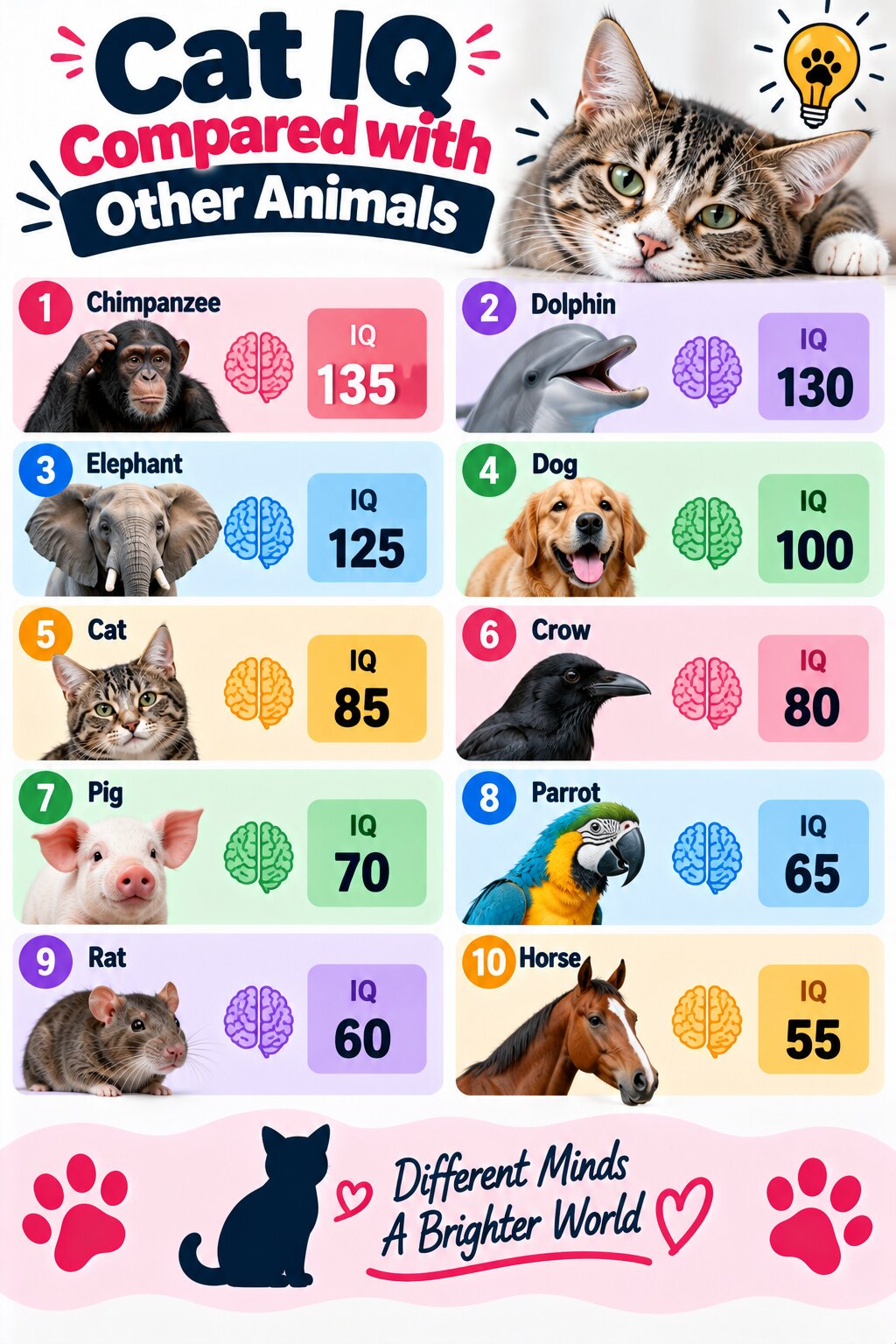
The truth is that cats do not have an officially measurable IQ score.
Human IQ tests measure abilities such as:
- Language
- Mathematics
- Logic
- Abstract reasoning
Cats cannot complete these tests.
Therefore, assigning a specific IQ number to cats is impossible.
However, researchers estimate that cats possess cognitive abilities comparable to those of a human toddler in some areas.
This comparison remains approximate rather than scientific.
How Smart Are House Cats?
House cats often display intelligence every day.
Examples include:
- Learning feeding times
- Recognizing family members
- Opening doors
- Finding hidden treats
- Using puzzle feeders
- Manipulating owners for attention
Indoor cats may become especially skilled at solving household challenges because they spend more time interacting with people and environmental enrichment.
Signs of an Intelligent Cat
Some cats appear noticeably smarter than others.
Common signs include:
1. Quickly Learning Routines
Smart cats rapidly understand:
- Meal schedules
- Bedtimes
- Work routines
They often anticipate events before they happen.
2. Opening Doors or Cabinets
Many intelligent cats learn:
- Door handles
- Cabinet latches
- Sliding doors
This behavior demonstrates strong problem-solving skills.
3. Solving Puzzle Toys
Cats that quickly master food puzzles often show advanced cognitive abilities.
4. Learning Tricks
Some cats learn:
- Sit
- High-five
- Spin
- Fetch
Training success often reflects intelligence and motivation.
5. Observing Before Acting
Highly intelligent cats frequently study situations carefully before making decisions.
6. Communicating Effectively
Smart cats often develop unique methods to communicate with humans.
Examples include:
- Specific vocalizations
- Paw gestures
- Eye contact
- Object manipulation
7. Escaping Containment
Cats that consistently escape closed spaces often possess exceptional problem-solving abilities.
Can Cats Learn Tricks?
Absolutely.
Many people assume cats cannot be trained.
In reality, cats can learn numerous behaviors.
Popular tricks include:
- Sit
- Come when called
- High-five
- Jump through hoops
- Fetch toys
- Ring bells
Positive reinforcement works best.
Treats, praise, and patience encourage learning.
Do Cats Understand Human Emotions?
Research suggests cats recognize aspects of human emotional expression.
Many cats respond differently to:
- Happy voices
- Angry voices
- Sad voices
Some cats even provide comfort when owners appear upset.
Although they may not understand emotions exactly as humans do, they clearly notice emotional cues.
Can Cats Remember People?
Yes.
Cats possess strong long-term memory.
Many cats remember:
- Owners
- Family members
- Other pets
- Important locations
Some cats recognize owners even after extended separations.
Memory plays an important role in feline intelligence.
Do Cats Have Episodic Memory?
Researchers believe cats possess a form of episodic-like memory.
This means they may remember:
- Specific experiences
- Particular events
- Previous outcomes
For example, a cat may remember where treats were hidden yesterday and return to that location later.
Smartest Cat Breeds
Individual personality matters more than breed.
However, several breeds frequently rank among the most intelligent.
Abyssinian
Often considered one of the smartest cat breeds.
Traits include:
- Curiosity
- Problem-solving
- High activity levels
Bengal
Bengals are known for:
- Exceptional curiosity
- Learning ability
- Interactive behavior
Siamese
Siamese cats frequently display:
- Strong communication skills
- Fast learning
- Social intelligence
Burmese
These cats often enjoy learning games and tricks.
Savannah
Savannah cats demonstrate advanced curiosity and adaptability.
Maine Coon
Maine Coons combine intelligence with gentle personalities.
Many learn household routines quickly.
🧠 How to Test Your Cat’s Intelligence
1. Problem‑Solving
- String Pull Challenge: Tie a treat or toy to a string and place it just out of reach. See if your cat pulls the string to retrieve it.
- Puzzle Feeders: Offer food in a puzzle toy. Cats that quickly figure it out show adaptability and reasoning skills.
2. Memory & Object Permanence
- Hidden Object Test: Hide a treat under a cup in full view. Wait 30–60 seconds, then let your cat search. Success shows short‑term memory and object permanence.
- Drawer Test: Place a toy in a drawer and see if your cat remembers where it went.
3. Social Learning
- Name Recognition: Call your cat’s name among other words. If they respond specifically to their name, they can discriminate sounds.
- Pointing Test: Place two identical containers, bait one, and point to it. Cats that follow the gesture show social cue comprehension.
- Slow Blink Response: Blink slowly at your cat. If they blink back or approach, it indicates emotional intelligence and trust.
4. Sensory Inference
- Sound Test: Shake a container with a ball inside, then tip it over. Cats that notice mismatches between sound and contents show logical inference.
Key Insights
- Cats vary widely: Some excel at problem‑solving, others at social cues.
- Motivation matters: A cat ignoring a test isn’t “dumb” — they may just be unmotivated.
- Playful approach: Keep sessions short and fun; stop if your cat seems stressed.
- No IQ score: These tests reveal cognitive strengths, not a number.
Can You Increase a Cat’s Intelligence?
You cannot dramatically change natural intelligence.
However, you can improve mental stimulation.
Interactive Toys
Puzzle toys encourage problem-solving.
Training Sessions
Short training sessions challenge the brain.
Exploration Opportunities
Safe exploration builds confidence and adaptability.
Playtime
Regular play exercises both mind and body.
Environmental Enrichment
Provide:
- Cat trees
- Window perches
- Tunnels
- Puzzle feeders
Mental exercise supports cognitive health.
Final Thoughts
Cats are far smarter than many people realize. While they do not demonstrate intelligence in the same way dogs or humans do, they possess impressive memory, problem-solving abilities, adaptability, and environmental awareness. Their independent nature sometimes hides their intelligence, but observant owners quickly discover how clever cats can be.
Whether your cat learns tricks, opens doors, solves puzzles, or simply manipulates you into providing extra treats, feline intelligence is one of the many reasons cats remain such fascinating companions.
Frequently Asked Questions
How smart are cats compared to humans?
Humans are far more intelligent overall, but cats outperform humans in some sensory and survival-related abilities.
Do cats have an IQ?
Cats do not have an officially measurable IQ score like humans.
Are cats smarter than dogs?
Cats and dogs excel in different areas of intelligence, making direct comparisons difficult.
Can cats learn tricks?
Yes. Many cats can learn tricks through positive reinforcement training.
Do cats remember their owners?
Yes. Cats often remember owners for long periods.
What are signs of an intelligent cat?
Problem-solving, quick learning, effective communication, and adaptability are common signs.
What is the smartest cat breed?
The Abyssinian is frequently considered one of the smartest cat breeds.
Do cats understand human emotions?
Cats recognize many human emotional cues and often respond accordingly.
Do cats have long-term memory?
Yes. Cats possess strong long-term memory abilities.
Can puzzle toys make cats smarter?
Puzzle toys help exercise the brain and support cognitive development.

Tammy is the passionate cat enthusiast behind Absolutely Cats. Her journey began with a childhood filled with furry companions, leading her to advocate for cat well-being and a connoisseur of all things feline. Tammy’s dedication to the world of cats is evident in every article, guide, and review she pens.